

Special Branch was highly popular during its tenure as Thames TV’s top police show from 1969-1970 and 1973-1974. I had limited knowledge about the series before watching it but vaguely remembered reading about the various changes the show underwent, many of which are evident in Series 1 and 2.
The action is centered on members of the Special Branch counterintelligence and counterterrorism unit of the London Metropolitan Police led by Detective Superintendent Eden (Wensley Pithey), who often clashes with Charles Moxon (Morris Perry), a high-ranking civil servant. Derren Nesbitt stars as Detective Chief Inspector Elliot Jordan, a much younger officer than his peers, throughout the first and second series
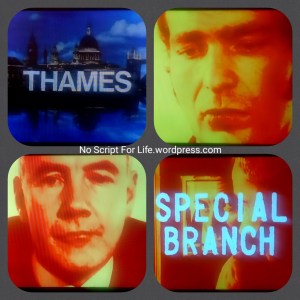
The first series of 14 episodes demonstrates the evolution the series went through. The first 9 episodes were filmed in black and white, but with Eden’s exit, the show transitions into color, and Fulton Mackay’s Detective Superintendent Inman arrives. The opening title sequence was revamped for Series 2, establishing Nesbitt and Mackay as the stars of the show. It was a lot of fun seeing them in roles different to those I’ve seen them play elsewhere, but the chemistry takes a while to reach the screen.
Morris Perry was excellent as the slimy civil servant, Charles Moxon, but I found him one of the most irritating characters ever invented for television. Multiple episodes end the same way; the target escapes with Jordan or Inman’s plans in disarray, and Moxon raises a supercilious eyebrow to say something like, “Yes, but that was my plan all along…” It became a little repetitive halfway through the second series because it rendered the preceding 50 minutes of drama virtually redundant.
An arch puppeteer such as Moxon provided a natural catalyst for the transition (it is Moxon who maneuvers Eden out of the way), but the character is so all-powerful, Special Branch is often outsmarted.
Promoted to a high rank at a young age, Jordan provides generational contrast to Eden, Moxon, and later Inman. He’s efficient and professional but doesn’t have time for bureaucrats or protocol. Inman can’t escape the bureaucracy, nor could the dogmatic Eden who resented Jordan’s rank and youth. Nesbitt plays the role with sardonic charm, demonstrating the character’s determination to disinherit the cynicism of the mature senior officers. The theme of contrasting ages among the ranks ends with the arrival of Inman who is closer in age (though still some ten years older).
Like a lot of 21st-century viewers, I recognise Fulton Mackay best from his comedy roles (Porridge mainly) but I also enjoyed his ‘straight’ acting in Doctor Who (1970). His appearance in Special Branch was another pleasant surprise. Sadly, both character and characterisation are rather dry. Inman is incorruptible but bendable. How far he will bend to accommodate Moxon or excuse Jordan’s methods is the most interesting thing about him. Mackay plays Inman as slightly socially awkward. It’s an interesting choice that adds nuance to an otherwise thin character.
Halfway through the second series, Detectives Chalk and Cheese attempt, and fail, to bond in their leisure time. It’s played with such exemplary awkwardness, the audience can see they will never be chummy.
The semi-regular characters of Special Branch are underserved by the scriptwriters. Although Detective Constable John Morrissey (Keith Washington) had a whole episode devoted to his chaste dalliance with a woman awaiting deportation (You Don’t Exist, S1 E9), he faded away without explanation during Series 2. Younger even than Jordan, the inexperienced Morrissey kept the intergenerational theme running. Detective Sergeant Helen Webb was empowered and efficient. Although played well by Jennifer Wilson, the character’s phase-out is completed by Series 2. Only Jordan and the conniving Moxon survive the transition.

Character development in this type of show didn’t have much currency in the era of television during which Special Branch was produced. Scriptwriters were primarily concerned with creating an engaging story and moving the narrative along at an arresting pace. Keeping the characters where they needed to be for ‘next week’s’ instalment. Unfortunately, but not surprisingly, there were no resolutions to the frustrations Jordan and Inman endured throughout the series while Moxon walked away with his supercilious eyebrow intact. A grievous oversight.
The conclusion to Series 2 explains neatly, if tartly, that intelligence work is a job for life, whether one wants it or not. It’s logical and echoes true life but is unyielding to the demands of the audience.
Despite its flaws, the first two series of Special Branch are a classic slice of British television boasting intelligent scripts and diverse plots. Time and again the series proved adept at moving with the times and the ever-developing medium of television.
Both Series 1 and 2 were immensely enjoyable to watch. There were plenty of surprises: the opening two-parter, the exciting episode where a police detective is assassinated, the stylistic retro opening titles to Series 2… There were many high points throughout but the highlight for me was Derren Nesbitt. I’ve seen him make one-off appearances in The Prisoner, Doctor Who and Fraud Squad but always wanted to see him play the lead role in an ongoing series. I didn’t know he was one of the leads in 27 episodes of Special Branch. At times, given unwieldy dialogue and on one occasion acting his way through a nasty head cold, he battled on through the production shake-ups, remaining impervious in the waters of Thames. Special Branch won’t be the same without him. Literally.
There’s one more vague nugget of information I recall about Special Branch: Big changes occurred in 1973 when Thames resurrected the show for Series 3. The method of multi-camera studio recording on Videotape is changed in favour of a greater use of real locations and recorded entirely on Film. The series became more action-packed, almost a blueprint for the style of The Sweeney and The Professionals. As I’m not a fan of either, the next phase of the show may not be to my taste. Alas.
I have enjoyed my time watching the first two series of Special Branch but like Jordan, I can feel it might be time to move on.
Copyright Martin Gregory 2026
The Man in Room 17

A newly-researched guide to the first series of Robin Chapman’s classic drama.
Available to buy now in multiple formats

Discover more from No_Script_For_Life
Subscribe to get the latest posts sent to your email.


One thought on “Review: 1960s Drama Special Branch”