
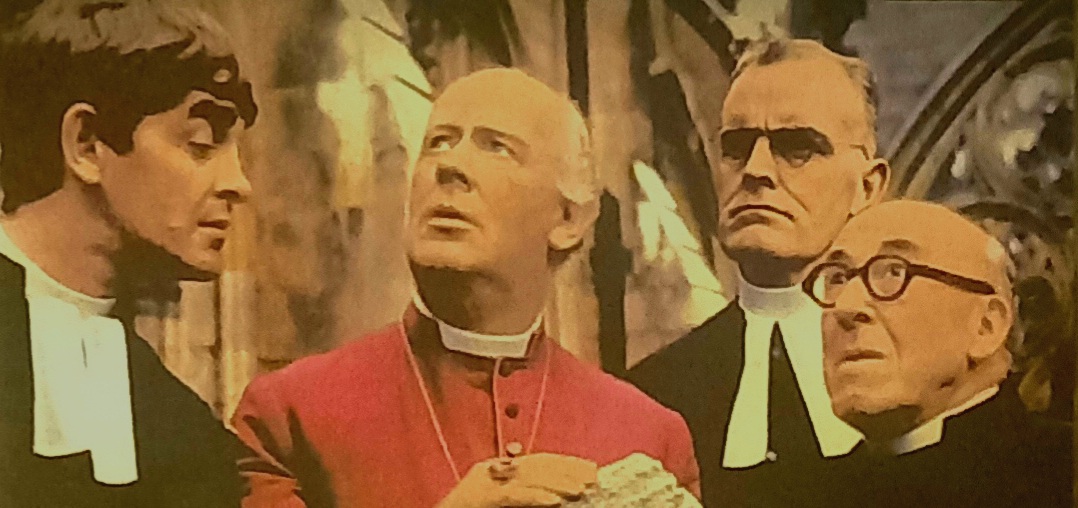
5 Series / 33 Episodes / Original television broadcast 1967 – 1971 / BBC Television
Spoiler-free review
Between 1968 and 1971, “All Gas and Gaiters” was one of the highest-rated and well-loved shows on television. Set around the fictional Cathedral of Saint Og’s, the series follows The Bishop (William Mervyn) in his attempts to run a well-ordered but laid-back diocese, despite the incompetent naivety of his chaplain Loote (played by Derrick Nimo) and the tipple-loving Archdeacon Henry (comedy legend Robertson Hare), while the Dean Pugh-Critchley (John Baron) constantly threatens the Bishop’s cozy existence with his reformist agenda.
Plots usually revolve around the rivalry between the pompous but sympathetic Bishop and the austere, slightly anally retentive Dean. Hapless bystanders, such as Henry and Noote, are drawn further into a tangled web.
This was a departure from my usual lineup of classic television. Having been put off by an episode of Hancock featuring noticeable set and prop malfunctions, I mostly avoid sitcoms from the 1960s (Dad’s Army being a notable exception). “It’s Dark Outside” and “Mr. Rose” are two series from the mid-1960s that I recently enjoyed very much, both starring William Mervyn (as Rose). After discovering that the actor was also in “All Gas and Gaiters,” I was curious to see him in an overtly comic role.
The phrase “gas and gaiters” is generally taken to mean ‘a satisfactory state of affairs’ or ’empty, meaningless or pompous talk or opinions’ or simply ‘nonsense’ The phrase comes from a nonsense-spouting character in Charles Dickens’ ‘Nicholas Nickleby’ who orders “bottled lightning” as well as a “thunder sandwich” and later describes the calm exterior of another, Miss La Creevy, “all is gas and gaiters”. Other writers such P.G. Woodhouse used it too.
The novel ecclesiastical setting provided a constant source of inspiration for husband and wife actors turned screenwriters, Pauline Devaney and Edwin Apps. Shrewdly choosing the Church as a source of subject-matter for their 30-minute play, the first episode in the fifth series of the strand, Comedy Playhouse, proved a hit. Lifting the lid on rivalries among the clergy offered great storyline potential for the distinct, well-crafted central characters.
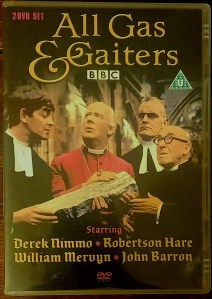
Henry is an incorrigible sherry hunter and skive artist. Always choosing the least laborious route, he’s loyal but unreliable. The audience can’t help but hope he succeeds in eluding responsibility and the meddling Dean.
Noote is too naive to see the Bishop as anything other than a stuck-in-his-ways village clergyman thrust into a demanding role. Though incorrigibly flustered, Noote displays intelligence and wit, often finding himself on the wrong end of a situation by a quirk of luck. He’s our sympathy figure, in contrast to the Bishop, who gets into sticky situations due to his own intransigence and verbosity.
Overbearing and bullish, the Dean is known for effective vocal admonishments. The ambitions of the Dean and his attempts to manipulate the Bishop are a recurring theme. In one episode, he affects the course of events, earning greater powers and responsibility in the process. In another episode, the cunning Dean contrived a plan to get a specific gift on his wedding anniversary. The best moments come when the character is forced to change course or realises his error in some way.
William Mervyn’s pompous Bishop is not averse to skiving off for a spot of fishing or sleeping during the Dean’s sermons. Often at the center of a rapidly escalating embarrassment, Mervyn makes us feel for his cosseted clergyman, frequently coming unstuck as the quiet life he so desires continues to elude him.
The cast of experienced actors had a great variety of previous roles between them. Robertson Hare was a veteran of farce with a huge collection of turns on the big screen and stage. He gives depth to a thin character, with a life off-camera. “All Gas and Gaiters” was his television swansong, but it was also where Derek Nimo gained renown for playing flustered clergymen (including “Oh, Brother”). William Mervyn was a well-known face in 1967, having just completed work on “Mr. Rose,” the third of the ‘Odd Man’ Trilogy. John Baron is usually best remembered for playing the bellowing chairman of Sunshine Deserts in “The Fall and Rise of Reginald Perrin” (and its spin-off, “The Legacy of Reginald Perrin”), but he also had a huge list of credits on his CV, before and after his turn as the precious Dean.
With my Hancock experience in mind, I expected one, possibly two episodes would satisfy my desire to see Mervyn in a comedy role and, ultimately, fulfill every one of my expectations. It is a joy, however, to type this article with my preconceptions in pieces.
A special effect of a ghost going through a wall was staged well. Although slightly indoors-y looking, a garden set rigged to aid surprising slapstick shenanigans was rather good too. Most impressive of all was a burial chamber inside the cathedral complete with swinging gates, railings, flagstones, sarcophagus, and an echo effect added in real-time to the actor’s speech. Occasionally, the gates swung unnaturally in a studio draft, revealing their balsa wood construction, but they were convincing enough for a comedy program.
Also impressive is the guest cast which includes John Le Mesurier, James Beck, Joan Sanderson, and Roy Kinnear.
This is fun, funny, highly inoffensive stuff. Suitable for all ages, all walks of life, modern audiences, fans of classic shows, and old-time radio. These days, we call it ‘gentle comedy,’ but back then, it was just ‘comedy.’ “All Gas and Gaiters” is remarkably genteel. Arguments are well-mannered, and characters exist in a state of polite bafflement while the tight ensemble cast creates a warm atmosphere. The series calls to mind later gentle sitcoms like “After Henry” and “As Time Goes By.” They all share the same convivial spirit inherent in the scripting of each joke and situation. If you enjoy vintage television, this genial 30-minute comedy from the BBC is a particularly warm example. It is one of the most fun and undemanding things I’ve found recently. A real gas.
In Other Media
Radio: When “All Gas and Gaiters” completed its highly popular television run the cast recorded adapted television scripts for BBC Radio. Every member of the cast reprised their roles, with Jonathan Cecil taking over from Derek Nimmo for the second series of twenty episodes. with After many years where the archive ststus was in question, happily, all the episodes made for radio exist – in states of varying quality. Many episodes are available on BBC Sounds and can be downloaded on Audible.
In 2016, a radio drama based on the story behind the making of the series. ‘All Mouth and Trousers’ was written by Mark Burgess for BBC Radio 4. The production featured John Sessions as Frank Muir and Nicholas Boulton as Stuart Allen. Gareth Williams played William Mervyn, Trevor Littledale as Robertson Hare, Zeb Soanes as Derek Nimmo and the ever-reliable David Collings as John Barron.
Books: In 2015, Durpey Allen published Devaney and Apps’ scripts for eight of the lost (i.e. missing) television episodes in paperback ( “Only Three Can Play”, “The Dean Goes Primitive”, “The Bishop Goes To Town”, “The Bishop Learns the Facts”, “The Bishop is Hospitable”, “The Bishop Takes a Holiday”, “The Affair at Cookham Lock” and “The Bishop Gives a Shove”)
Intended as the first of four volumes, only one volume of All Gas and Gaiters The Lost Scripts was published, with introductions to each episode in the form of conversations between the authors, sharing memories of the writing process and documenting the difficulties tencountered within the BBC hierachy. The book is now out of print and only available through second-hand outlets.
On Stage: Footage for the series 5 story, “The Bishop Has A Rest” were filmed in and around Chichester Cathedral. Other episodes or exterior shots may also have been filmed in Chichester. The DVD booklet alleges: “The title sequence featuring the central characters playing croquet was filmed in Chichester”, but this has been disputed in recent years. This, perhaps tenuous link, between the series and the town inspired the Chichester Players to adapting three of the scripts into a stage production which premiered in 2016.
Blu-Ray: Every episode of the fifth series was recorded in colour, however two episodes, “The Bishop Warms Up” (it’s about central heating and “The Bishop Entertains”. are preserved as black and white 16mm film recordings only. The programmes will likely retain the chroma dots (a vestige of the colour recording) which would allow further episodes to be re-coloured, in a similar fashion to other BBC archive releases (most notably ‘Doctor Who’), for a Blu-Ray release
The DVD
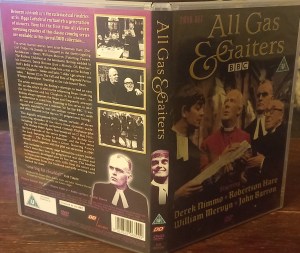
There are two DVDs of All Gas and Gaiters available on the market. Both double-disc sets contain the same eleven surviving episodes released by DD. Additionally, they include a twenty-page behind-the-scenes booklet that describes how the program was devised and developed over its five series. The booklet is illustrated with stills from the series and recollections from the husband-and-wife writing team behind the show.
Customers who reviewed the item on Amazon dating back to 2020 noted that their set did not contain a booklet. There is no way of knowing whether the latest iteration of the set still includes the booklet or if those without it purchased a second-hand DVD set missing the booklet. It was important to me that the version I owned came with the booklet. If it’s important to you too, I advise caution. I found a seller on eBay who had taken photographs of the DVD set they were selling, which I bought for £7.50, including postage.
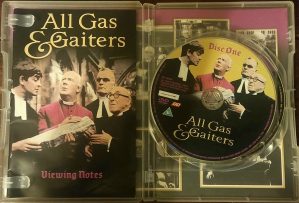
Though the cover is a heavily recycled image from the Radio Times, it is a rare colour shot featuring the entire cast. However, it lacks quality and is not as pleasing on the eye as the bespoke image used for the cover on the other release.
On the inside, the back cover is a monochrome stills gallery, which is a nice touch. The DVD menus are straightforward, though the disembodied faces of the cast fade and morph at the foot of the screen, which I found mildly distracting.
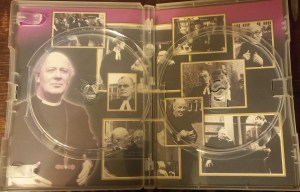
The series was another victim of the BBC’s videotape recycling system, leaving us with 11 episodes, five in color and six in black and white. Most surviving episodes are from the fifth series, which was broadcast entirely in colour. DD has done great work in restoring these episodes, but some of the black and white ones contain a lot of hiss, and the picture is less clear at times.
Every effort seems to have been made to present as comprehensive a release of this classic sitcom as possible, and for that, may the Lord make us truly thankful.
Copyright Martin Gregory 2026
The Man in Room 17
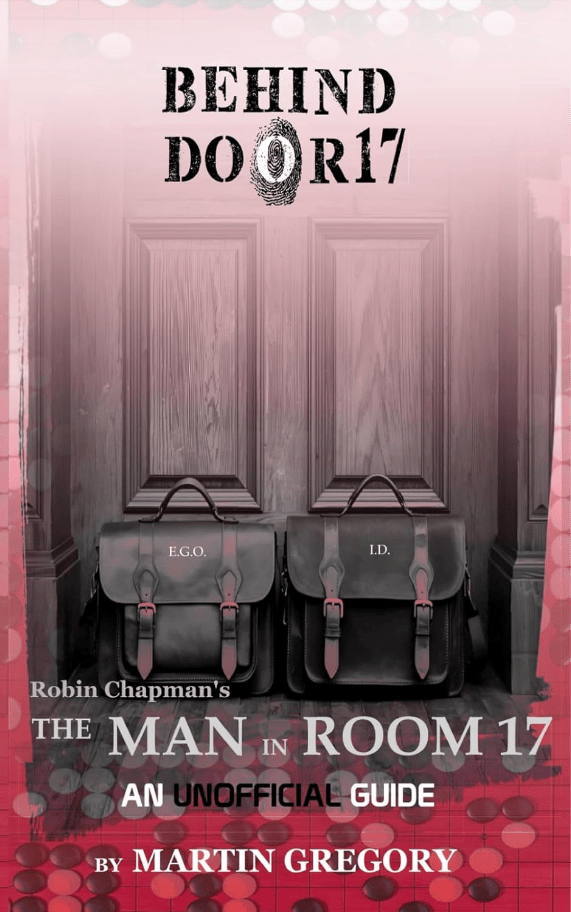
A newly-researched guide to the first series of Robin Chapman’s classic drama.
Available to buy now in multiple formats

Discover more from No_Script_For_Life
Subscribe to get the latest posts sent to your email.


I remember gas and gaiters it was something the whole family would sit and watch. One of my dad’s favourites that I had forgotten about until I read this review. Happy memories.
LikeLiked by 1 person
I’m delighted to hear the review unlocked some memories for you. thank you for sharing
LikeLike