
Contains mild spoilers
I collect the DVDs released by Network, even things I wouldn’t necessarily have a desire to watch, or even knew existed.
I picked up Edward and Mrs Simpson starring Edward Fox, in my local charity shop. It was £1, so at the very least I’d get a DVD with a Network badge to sit on the shelf next to the others. I was surprised when I watched it to find that although I am no great fan of costume drama, I enjoyed the story, the pace and the performances. It helped that it was no ordinary costume drama, it was at least based on something that happened. I wrote a full review, which you can read here.
I mention Edward and Mrs Simpson because it opened a door to period dramas I’d never really stepped through before.
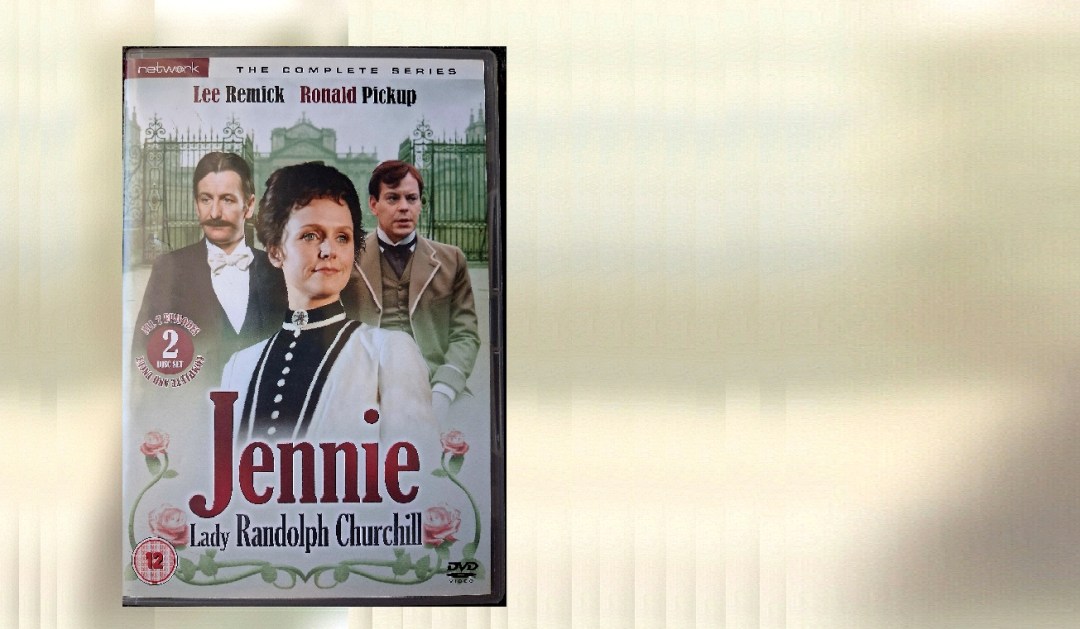
This time the charity shop had another period drama with a historical flavour, Jennie: Lady Randolph Churchill.
Jennie, a US citizen, became Lady Randolph Churchill by marriage, and later by deed poll when a subsequent marriage collapsed and she reverted to her first married name. Her eldest son, Winston, would become one of the most famous and recognisable politicians of all time when he became leader of the British Conservative Party and led the country to victory in the Second World War.
Though recent biographers revel in the acrimony often created in his wake, Winston Churchill was still a cultural icon in 1974 when this series was made. In his diaries, Winston’s devotion to his mother and admiration of her determination and drive is completely naked. She is the atlas of his world, even after her sudden death, she remained the axis on which it spun. Presumably, that’s what made this such a tantalising prospect for a mini-series.
Broadcast in 1974, nine years after the real Churchill went to the grand debating chamber in the sky, his is the shadow that looms over this production, because although he appears only as a young man, his story is the one everyone at the time cared about. The question, what must his mother, whom he worshipped from afar, have been like?
Jennie Jerome, a high society beauty had brains and wit. With such a formidable combination, she rubbed shoulders with royalty, aristocracy, officers and gentleman. Such women rarely make friends of their own sex, but Jennie was different. Her personality fills a room and she refuses to mince words or moderate her speech (does that remind you of anyone?)
She chartered the hospital ship RFA Maine to care for those wounded in the Second Boer War and created the bookazine, The Anglo-Saxon Review. Upon marrying Randolph she was no longer supported by her family, creating financial pressures the lady attempts to alleviate by writing her memoirs and plays.
Lee Remick (who cult film fans will instantly recognise from The Omen), is aged up and down to play Jennie throughout different stages of her life. The first thing to say is how very well this was achieved on screen, with the actress adding pep and vital notes to her voice playing young and wide-eyed Jennie, slow and husky when playing her older. It’s a studied portrayal, flattering but thoughtful and at times, rather stark. Her philandering is not played down, nor are there any concessions to real-life counterpart in the episode where her first husband is dying while she continues an affair with Count Karel Kinsky (Jeremy Brett).
Lady Randolph’s imperious impatience is also on display. Her brain moves through the gears quickly, leaving others on the back foot. Again we see those aspects of the great man reflecting back at us. And this is the crux of the piece; how much of Winnie’s famous personality came from his mother, and what qualities did he inherit from his father?
Ronald Pickup plays Lord Randolph Churchill, from whom Winston inherited his political aspirations. He was a far more shrewd and capable political animal than his father, one senses little patience in his father’s failed machinations (such as issuing an ultimatum in which he threatened to resign his position to destabilise his party’s government, force a general election and a debate on the issues in question). Randolph’s gambit doesn’t pay off. His resignation is accepted, and with illnesses creeping in, death seems not so far away.
Pickup makes us feel for his character, genuine sympathy which we never feel compelled to heap upon Jennie.
Her achievements speak for themselves, and though she was a vicious socialite with a wide and influential circle of friends, her passions translate to tangible action.
As ever with these archive releases, the names and faces that appear are astonishing.
Patrick Troughton playing an elderly Disraeli is a particular highlight. Though none can compare to seeing Jeremy Brett in full commanding glory, wearing the period costumes as if they were hand-stitched to measure. His ridiculous false moustache is rendered invisible due to the power of his physical presence on the set and complexity that he brings to the role.
Cyril Luckham makes an appearance early in the series as the Duke Marlborough (Winston’s grandfather) and Sian Phillips as the famed actress, Mrs Patrick Campbell. Zoe Wanamaker also appears in an early television role playing with Jennie’s most capable helpers.
Warren Clarke gives an understated performance. He could’ve picked out every one of Winnie’s vocal tics and physical signatures, but he’s far cleverer than that. Instead of offering a pot-pourri of Winnie-isms, he instead emulated the cadence and rhythm of his subject’s speech, inserting the infection and emphasis at the right time, and just enough of the former prime-minister’s vocalisms to convince.
Lady Randolph Churchill was in her third, and happiest, marriage when she slipped and fell down a staircase. Her leg required amputation, and she died from a hemorrhage shortly after due to the operation.
The mini series was well received on both sides of the atlantic, it won six Primetime Emmy awards, including for Outstanding Limited Series and four BAFTAs. Lee Remick was nominated for a Best Actress Emmy, while director Cellan Jones won a Director’s Guild of America award for Outstanding Directorial Achievement. (On the back of the DVD, it says Lee Remick was honoured with the International Churchill Societies’ Blenheim Award in 1991.
I would be highly surprised – floored, actually – if Jennie: Lady Randolph Churchill sat at the top of anyone’s ‘Must Have’ list. I doubt if the recently-revived Network Distribution, Future Network or Old Gold Media will be fighting to release the blu-ray. Until I found the DVD in my local charity shop, I’d never even heard of it.
To us today, Lady Randolph Churchill is a rather unusual choice as the subject of a mini-series, but in the 1970s Winston Churchill was a revered national treasure and there was an appetite for more on the great man. From our modern perspective, it’s difficult to imagine any former Prime-Minister or public figure so universally revered that people would watch a drama series about their mum! But, for me, that’s where a lot of the charm of this series, and vintage television in general is often found, in the delightfully unexpected.
The 7-part series was produced by Thames Television and recorded on location at Blenheim Palace (the Churchill’s long-held family seat in Blenheim, South Germany). It transmitted in the UK from 5th November – 17th December and written by screenwriter and playwright, Julian Mitchell (who would later turn in ten scripts for ITVs Inspector Morse).
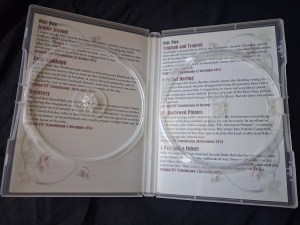
The DVD is a pretty standard release, but the care is still present. A brief episode synopsis is on the inside cover, which is often more than you get with non-Network releases.
The series was filmed on videotape, so we get a nice clean transfer to DVD, and the sound is pin perfect throughout.
The series does not move quickly, but steadily through the lives of it’s subjects, who are treated with respect. Not reduced to caricature, the archive nature of this series places it closer in time to the events it depicts, making it a genuine curio for history buffs and for those of us who like it when drama stops to ponder, to sit with the weight of events before hitting us with more. For those of us who like our period dramas to creak a little.
Am I becoming a man who enjoys costume drama? I actually don’t know. But I am increasingly enjoying period drama. What does this mean? Churchill said it best, so the last word goes to Winnie, “My tastes are simple: I am easily satisfied with the best.”
This title has been deleted but is still available via second-hand outlets such as Amazon, Ebay and CEX (to name a few).
Copyright Martin Gregory 2026
If you like tales with a retro feel and vintage vibes, explore my fiction on Amazon:
- Morrison’s Ghost — A novella filled with twists, dark secrets, and the twisted machinations of the state affecting ordinary people (available now in multiple formats).
- Phil’s Marvellous Machine — An upcoming collection featuring two crime/detective stories.

The Man in Room 17
A newly-researched guide to the first series of Robin Chapman’s classic drama. Available to buy now in paperback and for Kindle. READ AN EXTRACT

Discover more from No_Script_For_Life
Subscribe to get the latest posts sent to your email.


