
Contains mild spoilers
Jago and Litefoot
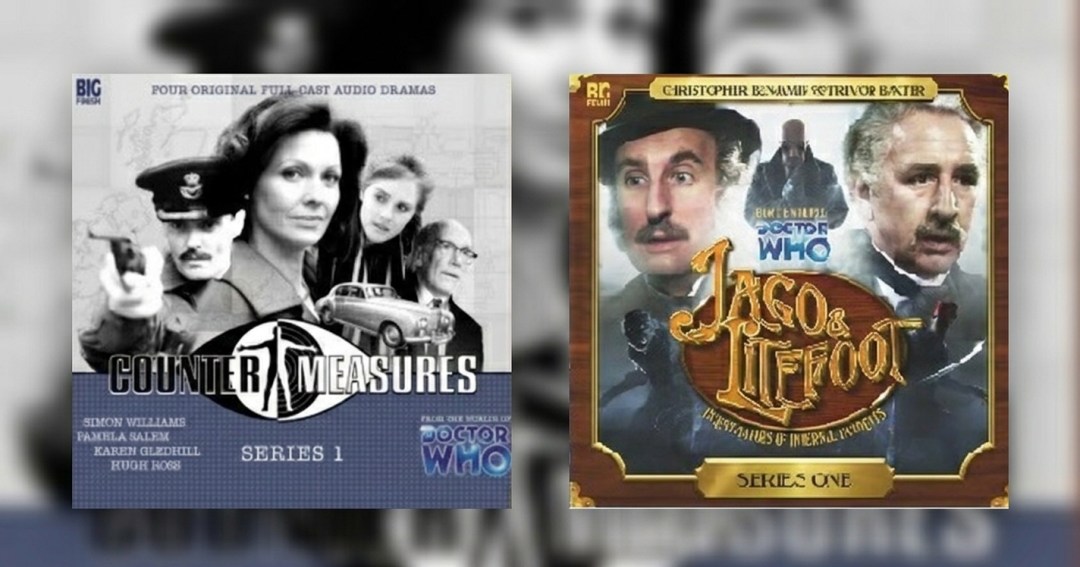
Starring Christopher Benjamin and Trevor Baxter. 13 x 4-part full-cast series released as ‘box sets’ from 2010 – 2017 by various writers.
Henry Gordon Jago (Benjamin) is a theatre impresario, master of ceremonies, a booker of talents, and king of the art of alliteration. His best friend is Professor George Litefoot, a police pathologist and an all-round quality upper-class gentleman. It’s a rum setup for these stories, set in the fog-bound, cobbled streets of old Victorian London, in a familiar world of horse-drawn cabs, lamp lighters—and, erm, aliens made of wood.
You’d be forgiven for thinking the premise—two investigators of infernal machinations dealing with odd, unexplained, ghostly, and (sometimes) alien things the police can’t cope with—sounds a little like Doctor Who. That’s because the two characters did indeed originate in one of the Tom Baker serials from the 1970s, created by one of the most prolific writers the show ever had: a chap called Robert Holmes. By rights, Holmes should have become a famous television playwright, but he confined himself too much to niche, cult programming, forever shunning offers of more prestigious work. Perhaps due to low self-esteem or simply a desire to write for a genre he enjoyed and felt gave him freedom. One thing is certain: apart from being adept at world-building in the most effortless manner, Holmes invented memorable double-acts in his Doctor Who scripts. Henry Gordon Jago and Professor Litefoot are one such pair. They proved popular enough in their solitary outing that the BBC almost commissioned a spin-off series for the duo. Unfortunately, that never came to pass—at least not on television. Happily, some thirty years later, the actors were able to reprise their roles for Big Finish audios in a new series of hour-long dramas.
So who are they? Litefoot is a refined gentleman—dignified, and holds his head high in polite society. Henry Jago, while perfectly respectable, is a bit of a rogue. By rights, these two are at opposite ends of the social spectrum and should never have met, much less enjoy a firm friendship. But they have something in common: one day they met the Doctor and realised there was more to London than they ever imagined—a dark underbelly where evil festers, occasionally bubbling to the surface as something nightmarish. It’s a fantastic premise for a series. Being at opposite ends of the class spectrum instantly gives the characters a little frisson, and their occupations offer possibilities for a wide range of stories.
Since its acclaimed launch in 2010, at least ten box sets of the series have been released, each with its own distinct flavor. The first series provides four chilling tales, with plenty of horror and only a dash of science fiction. The second set of four adventures, comprising series two, is much the same, but gives a larger part to the supporting characters, such as barmaid Ellie Higson and police Sergeant Quick. Series three sees the duo joined by a recurring character from Doctor Who, while series six sees them transported from Victorian London to the 1960s.
NEW! Phil’s Marvellous Machine and Other Stories
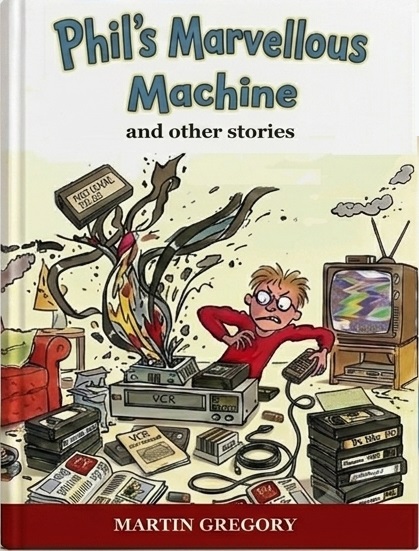
In 1980, a teenage Doctor Who fan becomes the unsuspecting owner of a marvellous machine—a video cassette recorder! | Preview on Amazon
Over the years, there have been many such developments and ideas brought in to mix things up—each with the potential to dilute the Victorian gothic that made the first few box sets so evocative. Series nine, for example, sees the stories taking place on a cruise ship bound for Monte Carlo. But Benjamin and Baxter inhabit their roles so completely that they make the series absolutely fireproof. You could put the intrepid investigators in virtually any setting and still they would be the same—which is why they eventually returned to their own time. A fine testament to the characters and the actors who gave such wonderful, immersive performances.
And that really is the strength. History’s wrongs were corrected, and the characters received their deserved series. But by then, Christopher Benjamin and Trevor Baxter were nearing the end of their careers (Baxter sadly passed away in 2017). Each had graced many a stage and screen over the decades, mostly in small character parts, so it’s lovely to know Jago and Litefoot reinvigorated these fine thesps of the old school. That they stepped back into the roles they had only occupied very briefly some thirty years ago so effortlessly is a testament to the strength of the characters Holmes created. Throughout the series, they continued to be served magnificently by sparkling, witty dialogue and superb, evocative mysteries.
Jago and Litefoot is available to buy from Bigfinish.com
Counter Measures (Series 1)
The 1960s were a tense time for international relations. Spies coming in from the cold were one thing, but the shrinking British Empire was also affecting ardent imperialists in the aftermath of the second world war. In the wider geopolitical landscape, leaders of wealthy nations wanted any scientific advance that might give their country an edge over enemies old and new, usually the Russians. There really was a post-war scramble for any technological developments from the recently collapsed Nazi empire. In the following years, the former allied countries eagerly recruited scientists whose research the Nazis had funded. Counter Measures is a drama set in these dark cold war days; a secret department created to expand the frontiers of knowledge, even if that knowledge comes from slightly dubious sources.
Starring Pamela Salem, Karen Gledhill and Michael Williams, the Counter Measures team encounters a wide range of odd scientific advances; mind control, teleportation, communication with the dead – there are many an old sci-fi trope inserted into this series, but that old maxim holds true here; it isn’t what you’ve got, it’s what you do with it that counts. Counter Measures nets all this standard sci-fi stuff but sets it loose in a realistic post-war world.
Counter Measures is a department set up by the British government and commanded by Professor Rachel Jenson (Salem), who joins the team in episode one, ousting the organisation’s former head, Group Captain Ian Gilmore (Williams), seconded from the RAF. Watched over by civil servant Tobias Kinsella (played by Hugh Ross) and joined by the third member of their team scientist, Alison (Gledhill). It is the team of Gilmore, Jenson and Alison who are the main protagonists, but the most interesting character in the series is Kinsella. At first he comes across as a reliably stoic British government type, forever trying to satisfy his own superiors, ministers and serve his nation, he soon develops into a character with ambiguous morals, presumably to counteract the straight forward heroism of the Counter Measures team.
This is another Big Finish production where fine British actors get given some meaty material to work with. Simon Williams (Upstairs, Downstairs) and Pamela Salem (Bergerac) have been familiar faces on UK television for decades. As you’d expect, they absolutely leap at the chance to do something different, and do it in a series that is so brilliantly off-kilter with most audio drama it must have been a complete surprise and pleasure.
At least the first two series of Counter Measures (each comprising four hour-long stand-alone episodes) is very much made in the same vein as television programmes such as Granada’s The Man in Room 17, and Department S, The Baron and all those wonderful 1960s series produced by the powerhouse that was ITC Productions.
There really is no radio-drama equivalent to make comparisons, but if you’ve ever seen any of those aforementioned shows, you’ll see a very definite similarity of style. It’s warm, kind of cosy—and it absolutely should not work in today’s audio drama landscape. That style of television, and to a lesser degree radio, is now very much in the past, and putting such a visually heavy type of production on audio should fall flat on its arse. But it absolutely does not. The slight kitsch helps rather than hinders Counter Measures to develop its own unique style. And when things occasionally happen that absolutely would not be allowed in the more culturally sensitive post-war climes of 1960s television, it ups the ante most existentially. Once again Big Finish demonstrates that not only do they know their audience, but they are skilful at bending the rules of a genre they gleefully ape.
The series’ theme and incidental music show its ITC roots pretty blatantly. It’s eerily authentic, but eschews the conventions of the genre by being far more politically aware, bringing to mind would-be stablemates Undermind and Doomwatch—swapping international intrigue for British grit and double-think.
The Counter Measures team aren’t always running up against alien tech—in fact, the most chilling stories are where the threat comes from within. Sometimes within the establishment, or from unscrupulous businessmen. Sometimes from military men craving the thrill of war. And sometimes from the very corridors of power that Kinsella walks every day.
Counter Measures turns the clock back to when drama television was less sophisticated than it is now, and shows us what it would be like if that style was still in vogue in the twenty-first century. Can you put on a modern spin on a television cult 60s ‘spy-fi’? Download a box set or two of Counter Measures and you’ll see that you absolutely can—and totally nail it too.
Full-cast drama. 4 x 50 minute episodes released in a boxed set released in 2012.
Counter Measures can be purchased from Bigfinish.com.
Copyright Martin Gregory 2026
BRAND NEW! Phil’s Marvellous Machine and Other Stories
In 1980, a teenage Doctor Who fan becomes the unsuspecting owner of a marvellous machine—a video cassette recorder! | Preview on Amazon
The Man in Room 17
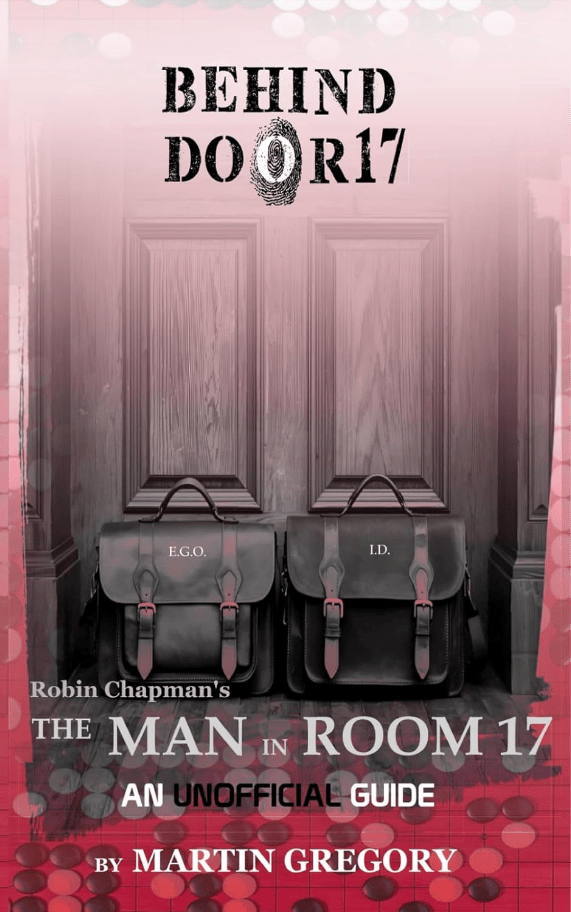
A newly-researched guide to the first series of Robin Chapman’s classic drama. Available to buy now in paperback and for Kindle.
Discover more from No_Script_For_Life
Subscribe to get the latest posts sent to your email.


