
A quote from a leading Television producer sticks in my mind;
“…it’s like ‘The Prisoner of Zenda’. Has anyone alive actually read it?”
I’ll spare the modesty of the originator of the quote. And I’ve forgotten why he took a swipe at Anthony Hope’s labyrinthine literary contribution. But the words stuck in my memory, not only because I happen to have read ‘The Prisoner of Zenda’, but because the comment alluded to something I felt after reading the book.
Sometimes titles are so memorable, so vivid you feel know the story already. Sometimes the title is the best thing about a story. Is The Prisoner of Zenda labelled a ‘classic’ and adapted for film and television multiple times, not because it rises above the pulp trappings of other novels printed around the same time, but simply because it has an interesting and evocative title?
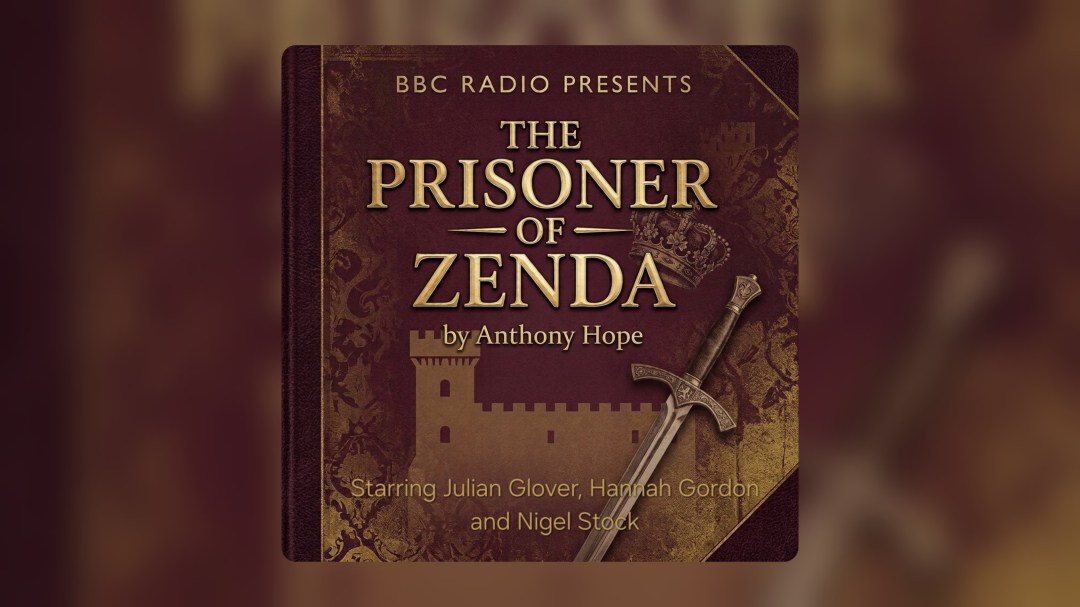
Julian Glover, Nigel Stock, Hannah Gordon and Martin Jarvis star in this feature-length BBC Radio dramatisation, first broadcast in 1973. Sticking closely to the narrative of Hope’s novel, this is a faithful adaptation.
The ‘Prisoner’ of the story’s title is the soon-to-be-crowned Prince Rudolf, who is the spitting image of a tourist to the country, Rudolf Rassendyll (played by Julian Glover). Even down to their distinctive red hair, they could be twins. They first encounter each other whilst the Prince is out hunting. This chance meeting is fortuitous because the Prince’s rival, ‘Black’ Duke Michael, wants to prevent his cousin from attending the coronation, first by drugging him, then by kidnapping and holding him prisoner in a castle-come-fortress at Zenda.
To save the people of the kingdom from the despotic rule of Michael, Rassendyll must attend the coronation to be crowned King and continue with the impersonation, until the royal personage can be rescued: if he doesn’t, Black Michael can use the no-show at the coronation to again highlight his cousin is unfit for high office, before he steps into the breach. It’s an intriguing and involving tale, built on a huge coincidence.
Mysteries, twists and chills.
A collection of ten short tales of mystery, twists spine-chilling accounts and exploding video recorders. Buy or PREVIEW
Feminism was not yet a word when Anthony Hope published his novel in 1894, it’s hardly surprising there are no decent roles for the women of the fictional Germanic kingdom of Ruritania, except the Countess Flavia, a love struck plot device.
The men are all honourable swordsman types, either socially gifted aristocrats or utter cads. Meanwhile, there are really only two speaking parts for women in this unashamedly male-dominated story; the insubstantial Madame, who wishes to protect Black Michael from ascending the throne (fearing his position will force him to marry someone else), and the Countess Flavia; reserved, well spoken and unimpeachable. Both thinly characterised purely by devotion to the men in their lives.
It is when this play strays from the bearable political machinations to the love story between Flavia and the imposter King that it becomes tiresome. All the great and grand proclamations of love become more elaborate as the play goes on. What reads in the book as something delicate and mostly unspoken, is here ground down to two haughty people telling each other how they feel in increasingly over-the-top ways.
I’ll put my cards in the table; I’m a bit of a sucker for a love story. But the subplot here is not a love story. He’s infatuated because she looks terrific in a frock, and she wants him because he’s King. They’ve got nothing in common, and actually he isn’t the King anyway.
The real Prince Rudolf is a womanising, wine-drenched fop, but the moment the crown gets plonked on “his” head she believes he’s suddenly changed by the weight of responsibility. The story here is that she loves Rassendyll (not the real Prince / King) but can never know for sure.
Romantic subplots are meat and drink for melodrama such as this, a brand of literature popularised by Hope’s Ruritanian story (a sequel, followed a few years later) but the OTT lovey-wovey stuff wore me down and obscured the body-double element of the story, which is the main thrust of the narrative, and the apparent threat from Michael.

Black Michael, the rotten apple who would be King, is portrayed as a slightly more sympathetic character in this play than the one found in Hope’s novel. Here, he is shown to have loyal subjects among the people, and though he is a cad, may possibly be a benevolent and capable one. It almost lends pathos to his machinations to gain the throne, but not quite. Given a slightly stronger emphasis, this adaptation might have found a new angle with which to approach the character, to make him more than just a moustache-twirling baddie. In the end we get just another archetype. But then in fairness so are all the characters.
Flavia is your archetypal breathless damsel, Rassendyll the typical swashbuckling hero (albeit a reluctant one) and the King’s right hand men, Colonel Sapt and Fritz Von Tarlenheim, are the sound counsel and loyal soldier respectively. Zenda, whilst set in a believable grown-up world, is really a fairytale. Kidnapped princes, sieges, castles moats, derring-do… It’s all here.
Nigel Stock plays Colonel Sapt. He’s always a reassuring presence in any production (including the science-fiction adventure serial, ‘SpaceForce’).
Julian Glover plays the lead, who has numerous, and prestigious, screen and stage credits to his name, chooses not to resist the clichés in the script.
As you’d expect from a BBC Radio production, this play boasts fine performances and high production values. An excellent cast was assembled and all give value for money in a play of very high quality indeed. That it wasn’t to my taste, should not deter you from seeking it out
The Prisoner of Zenda, like the character Rassendyll, prompts us to ask ourselves, ‘what’s in a name?’. If you’re in the market for some classic romance and adventure melodrama then this is fine fare . You may even enjoy it more than I did. Damn good title though.
Cast:
Rudolf Rassendyll / King Rudolf …. Julian Glover
Colonel Sapt …. Nigel Stock
Princess Flavia …. Hannah Gordon
Count Fritz …. David Timson
Rupert of Hentzau …. Martin Jarvis
Duke Michael …. Michael Spice
Antoinette de Mauban …. Anne Kidd
Lord Burlesdon …. Clive Swift
Lady Rose Burlesdon/ Innkeeper …. Diana Bishop
Countess Helga …. Hilda Schroder
Rosa …. Cherry Gilliam
Captain Detchard …. Terry Scully
Johann …. Sam Dastor
Josef …. Haydn Jones
Train guard …. William Sleigh
Bersonin …. David Gooderson
Customs officer …. Brian Haines
You can find the version of The Prisoner of Zenda reviewed here by searching the Internet.
BEHIND DOOR 17
Guide to Granada Television’s Cult 1965 Drama.
A newly researched and comprehensive guide to the first series of Robin Chapman’s elusive drama, The Man in Room 17.
An Off-Beat Thriller
A coming of age story and gripping eco-thriller. One invention will change everything
Editorial policy: This and all content within Awesome Audios was 100% written by a human being. No AI was employed in the writing of this feature. This work is all my own and nobody or nothing has permission to re-use it.
Martin Gregory 2026 copyright
Discover more from No_Script_For_Life
Subscribe to get the latest posts sent to your email.


